Case Study How Socure built developer experience into a moat with EkLine
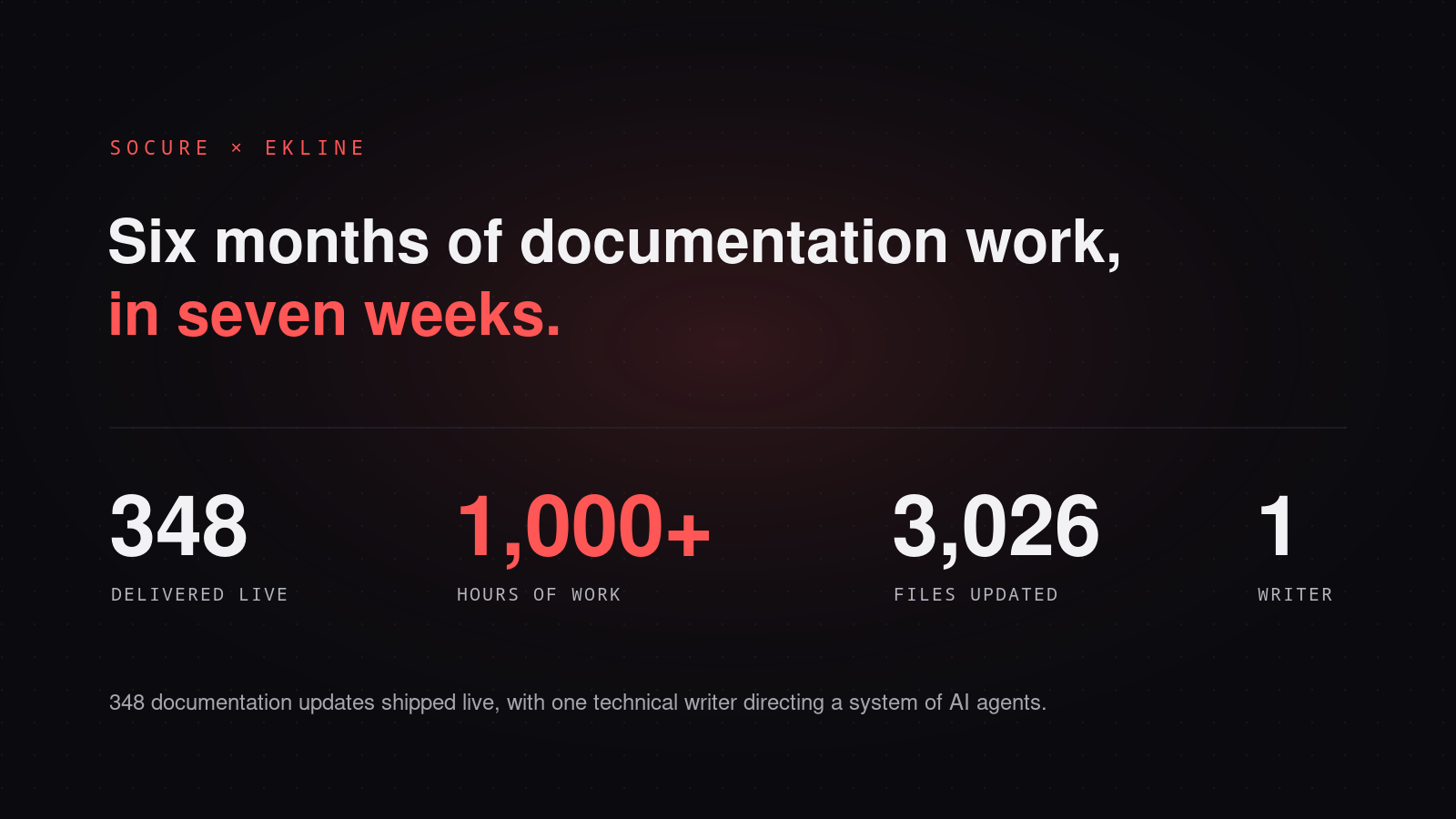
Customers go live on their own, AI coding assistants generate correct code against Socure's API, and one technical writer keeps 25+ products current: 348 documentation updates merged in seven weeks, more than 1,000 hours of work.
Socure is the leading AI-native trust infrastructure powering identity intelligence and risk decisions for enterprise and public sector organizations. Its customers integrate identity verification, fraud, risk and compliance checks into their own products to reduce fraud loss and enhance consumer experiences. The developers doing that work depend on Socure's documentation to go live quickly. Harish Srigiriraju leads developer experience at Socure. His view is that developer experience decides how fast a customer goes live, and that over time it becomes a competitive moat, the way it has for Stripe and Vercel. Building one with a single technical writer across 25+ products and two platforms is the problem he set out to solve. Today Socure's docs move at product speed, and the effects reach well beyond the docs team. This is how Socure built it with EkLine, an AI-native documentation platform for engineering teams.
At a glance
| Company | Socure, identity verification and fraud prevention |
| Documentation surface | 25+ products, two platforms, commercial and public sector editions |
| Documentation team | One technical writer |
| Using EkLine for | Keeping docs current with every release, closing gaps before customers hit them, making docs readable for AI agents |
| Results | Customers integrate on their own. Fewer questions reach product managers and engineers. Docs reviewed daily. AI readability score up from the 80s to 95. Nearly 10x more documentation PRs than before: 348 merged in seven weeks, an estimated 1,000+ hours of documentation work. |
Watch the conversation
The challenge: documentation could not keep pace with the product
Harish joined Socure to lead developer experience, and his first assignment was to revamp the public documentation. Working through it with product teams and leadership, he saw that documentation at Socure was never going to be a project with an end date. Socure actively ships new products and every release moves the docs a little further from the product. A moat built on developer experience only holds if the docs move at the speed of the product.
The practical problem sat with Peter Schwarck, Socure's senior technical writer. With 25+ products shipping constantly, product changes reached him through chat messages, tickets, and a release tracker, and working out which of them needed a documentation update was a job in itself. Most of his time went to individual requests, which left little room for planning or larger improvements.
That matters outside the docs team too. When a developer hits a question the docs do not answer yet, integration slows down, and an engineer or solution consultant steps in to help. Harish's view is that up-to-date and accurate docs help customers go live faster.
Why hiring more writers was not the answer
The obvious move was a bigger writing team. Harish decided against it. A writer, however good, has to be told what changed. Add five writers and you have five people waiting to be told what changed, or trying to embed themselves into every team's shipping process. That does not scale with the product.
What Socure needed was something that sits where the change happens: the codebase, the customer channels, the engineering workflow. That is what EkLine does.
How the docs get updated now: EkLine drafts, one writer reviews
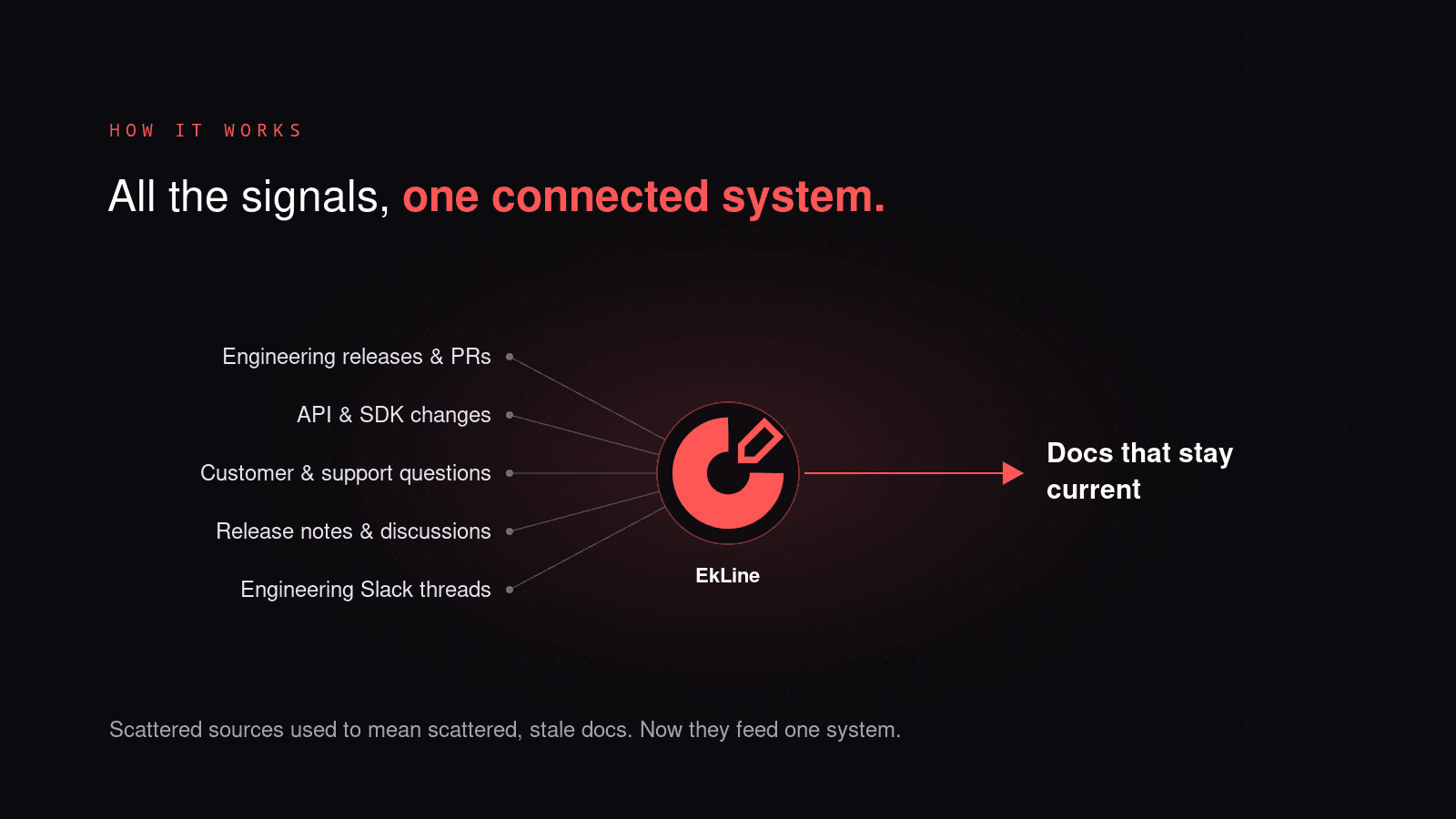
EkLine reviews every documentation change before it ships and raises the fix as a pull request. It is connected to the codebases Socure's engineers push to. When a pull request merges, a feature ships, or the UI changes, EkLine reads the code behind the change, rates it by confidence, and drafts the documentation update as a pull request. High confidence changes get a PR on their own. Lower confidence changes get a note for Peter to check. The same agents keep the commercial and public sector editions in sync, turn repeated customer questions into documentation, and audit the site for structure and readability.
Peter reviews and publishes. The review is fast because every draft starts from the source of truth, the code, and anything that needs a product or engineering opinion goes to that person on the PR EkLine already opened. His job changed from writing every page by hand to running the agents that write them, and to the information architecture work that had been waiting for bandwidth.
One technical writer is now managing an entire army of AI agents, continuously improving documentation quality, accuracy, and discoverability. Docs are now updated automatically to match the product velocity. I would have needed to hire a big team of technical writers without EkLine.
The results: five things that changed for Socure
When asked to rank the outcomes, Harish placed faster customer onboarding first, fewer questions second, and improved readability for AI third. Peter, however, argued that the three are inseparable because each contributes to Socure's growth.
Customers go live faster, on their own
With documentation this complete and current, customers build their integrations without an engineer or solution consultant walking them through it. EkLine finds gaps by reading the code and closes them before a customer runs into them. The time engineering and solution consultants spent on integration support goes back to product work and to the customers with harder problems.
Socure now has a solid developer experience foundation that enables customers to integrate without our team guiding them through every step. That frees up significant time for our engineers and solutions consultants. It also enables Socure to scale by serving more customers and delivering value through documentation alone.
Fewer questions land on product managers and engineers
Socure grew 60% year over year in 2026, and as the company expanded, so did the volume of customer questions. Many of those questions fell to product managers, solutions consultants, and engineers. Harish recognized that hiring alone could not keep pace with demand. Today, common questions are answered through the documentation or by AI agents that use it, freeing those teams to focus on higher-value work.
Docs are updated the day the code changes
Most teams publish a page, wait for someone to report a problem, and then fix it. Socure treats documentation as a continuous process. Updates are drafted on the same day that the code changes, the docs are reviewed daily, and critical pages are reviewed as often as hourly. Harish describes this as a shift from a one-time exercise to a process of continuous improvement.
AI agents give the right answers about Socure
Developers increasingly encounter Socure through an AI coding assistant before they ever open the documentation site. Usage of Socure's documentation platform has grown roughly fourfold in under a year, and a growing share of its users are now AI agents. That made two things critical: whether an agent could read documentation at all and whether the code it generated from that documentation would run.
Long integration guides were the first challenge, so Peter used EkLine to restructure them into smaller sections that agents can parse. EkLine's reviews also help keep the API reference correct for agents as dozens of enrichments and multiple SDKs evolve, including changes to field names, required fields, and response shapes. Socure's AI readability score, measured by an external tool, rose from the 80s to 95, and AI assistants now generate code that aligns with Socure's actual API surface.
It is not just developer experience anymore. It is agentic experience.
One writer, nearly 10x the output
In seven weeks, Socure's one technical writer merged 348 documentation updates across the full product line, the equivalent of more than 1,000 hours of documentation work, with no added headcount. Harish's public post put it at nearly 10x more documentation PRs than the previous monthly average.
What's next
Socure plans to roll EkLine out to more teams and a wider product surface, so the docs keep pace with the product. The next measurement is follow-through: Socure is instrumenting docs, MCP, and CLI adoption to track what developers do after they read the docs.
Now we have a much richer set of documentation that we can hand our customers, and they can build their own integrations.
About Socure
| Company | Socure |
| Industry | AI/security |
| Platforms documented | RiskOS and ID+ with 25+ products |
| Website | socure.com |
Socure is a global leader in identity verification and fraud prevention for enterprise and public sector organizations.
Frequently asked questions
How did Socure build developer experience into a moat?
By keeping its documentation accurate at the speed the product ships. Socure connected EkLine to its codebases and customer channels so that every code change, release, and repeated customer question turns into a documentation update that one technical writer reviews and publishes. Customers now integrate on their own, fewer questions reach product managers and engineers, and AI agents give correct answers about Socure's products.
What business results did Socure get from EkLine?
Socure's customers go live faster and integrate without waiting on Socure's engineers or solution consultants, fewer questions reach the teams building the product, documentation stays accurate as fast as the product ships, and Socure's AI readability score moved from the 80s to 95. One technical writer merged 348 documentation updates in seven weeks, the equivalent of more than 1,000 hours of documentation work, with no added headcount.
Why did Socure choose EkLine instead of hiring more technical writers?
More writers would still have to be told what changed. EkLine plugs into the software development lifecycle, customer channels, and engineering workflows, so it sees the change where it happens and drafts the update before anyone files a request.
How did Socure make its documentation readable for AI agents?
Long integration guides were restructured into smaller sections that AI coding assistants can parse, and EkLine's reviews keep field names, required fields, and response shapes in the docs matching the API. Socure measures AI readability with an external tool, and the score moved from the 80s to 95. AI assistants now generate code that matches Socure's real API surface.
What is EkLine?
EkLine is an AI-native documentation platform for engineering teams. It integrates with GitHub, chat, and customer support tools to turn code changes, customer questions, and product releases into accurate, current documentation that your team reviews and ships.
Built with EkLine, the AI-native documentation platform for engineering teams. Book a demo and see what EkLine finds in your docs in 15 days.